

This text was machine-translated.
Department
Prof. Dr.-Ing. Maren Petersen
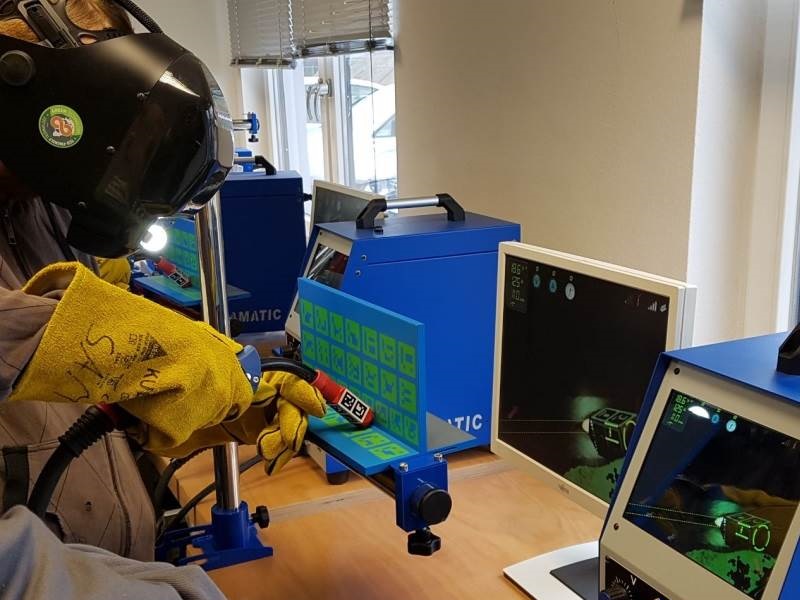
The starting point for research in the department is the relationship between work and technology in the context of vocational learning. Key areas of focus include the potential for shaping processes in the world of work and the associated educational processes. The research focuses on the fields of metal technology and automotive engineering.
Staff
-
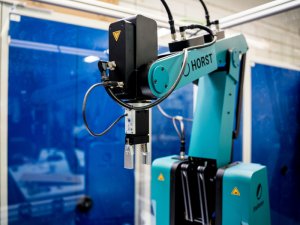 Robi HORST Industrieroboter
-
 Jan Naumann Research Associate
Projects
-
2025–2026
DIVE IN – Bringing digitalisation to life virtually in vocational education and training: A VR module for trainee teachers
The DIVE IN project is developing a module that uses virtual reality (VR) and collaborative robots (cobots) to provide trainee vocational school teachers with practical preparation for the reflective use of digital technologies in the classroom and for promoting their acceptance.
Svenja Gmeinder Christoph Leupold Prof. Dr.-Ing. Maren Petersen
-
2023–2027
WASABI – AI in human-centred manufacturing
WASABI will develop intelligent digital assistance solutions, thereby enabling SMEs to recruit new staff more quickly and to provide training and further education in a more efficient, employee-centred manner. The solutions will enable employees to interact with complex software using natural language, thereby meeting skills requirements.
-
2022–2023
DUBB – Digitalisation and Inequality in the Context of Vocational Education and Training in the State of Bremen
In the project ‘Digitalisation and Inequality in the Context of Vocational Education and Training’, vocational education and training is used as a ‘magnifying glass’ through which inequalities arising from digitalisation processes can be identified simultaneously at various levels of society, thereby clarifying questions regarding the origins and nature of these inequalities and developing recommendations for action.
Verena Honkomp-Wilkens Prof. Dr. Alisha M. B. Heinemann Prof. Dr.-Ing. Maren Petersen
-
2021–2024
KIM – Artificial Intelligence as a Mentor for Lifelong Learning
The collaborative project ‘KIM – Artificial Intelligence as a Mentor for Lifelong Learning’ aims to develop an AI solution that offers users of professional development platforms targeted guidance in choosing training programmes. The project focuses on users and their professional and career aspirations. Users begin by carrying out a self-assessment of their skills and outlining their current professional and career aspirations, as well as their personal preferences (e.g. free and paid courses, time constraints regarding course availability, etc.).
-
2021–2024
KIWI – Artificial intelligence for tailored further education and training to enhance employability in the face of increasing digitalisation in manufacturing within the context of Industry 4.0.
As part of the KIWI project, a smartphone app is being developed for production staff which, with the aid of artificial intelligence, enables a cross-platform search for tailored further education and training opportunities. Due to digitalisation and the associated increase in automation, the manufacturing sector is undergoing rapid change, which is also accompanied by shifts in job requirements and role profiles.
-
2021–2024
F.IT – Women in IT
More women in IT – but how? The “F.IT Women in IT” project is working to find the answer to this question. Through targeted training and further education programmes, the project aims to create opportunities for women to make a career change into the sector. To successfully achieve this goal, the sector’s needs and the requirements of the target group are being analysed.
-
2020–2023
tekom_LandBauMT – Technical communication in the learning and working processes of agricultural and construction machinery mechatronics technicians in the context of Industry 4.0
The ongoing digitalisation and networking in industry and the skilled trades are increasingly changing the requirements and tasks involved in the profession of agricultural and construction machinery mechatronics technician. Factors contributing to this include, amongst others, the increased use of diagnostic, analytical and design software in agricultural and construction machinery engineering, the growing use of high-voltage technology, the increasing interconnection of systems, and augmented, virtual and mixed reality technologies. However, inter-company training programmes for apprentices in agricultural and construction machinery mechatronics do not yet take sufficient account of this digital transformation. The ‘tekom_LandBauMT’ project addresses these challenges by modernising the inter-company training programmes for agricultural and construction machinery mechatronics technicians.
Dr. Vivian Harberts Nils Petermann Michael Sander Prof. Dr. Falk Howe Prof. Dr.-Ing. Maren Petersen
-
2020–2023
COALA – Cognitive-assisted agile manufacturing for a workforce supported by trustworthy artificial intelligence
People are at the heart of knowledge-intensive manufacturing processes. They must be skilled and flexible in order to meet the demands of their working environment. Training new staff in these processes is time-consuming and costly for companies. Industries such as the Italian textile sector are suffering from a shortage of skilled workers, caused, for example, by demographic change. A second challenge for the manufacturing sector is the constant competition from high-quality products. COALA will tackle both challenges through the innovative design and development of a voice-controlled digital intelligent assistant for the manufacturing sector.
-
2019–2020
WinATutor – Promoting educational e-learning application scenarios
The project developing an e-learning unit on ‘Good Research Practice’ receives internal university funding under ‘Win a Tutor – E-learning Teaching Scenarios’. Following the publication of revised DFG guidelines on good research practice in August 2019, the project will create and test an e-learning unit on the subject. It will comprise an interactive course and an online test. The slide-based course will include explanatory videos using current case studies, supplemented by learning checks and practical exercises.
-
2019–2022
KoRA – Virtual and augmented reality (VR/AR) in VET: developing competences for human–robot collaboration through a mixed-reality teaching and learning approach
The KoRA project is developing a teaching and learning concept designed to develop and promote skills in the field of collaborative robotics and the design of human-robot collaboration within vocational education and training. This is being implemented using mixed-reality learning software, in which complex assembly problems are solved in the form of learning and work tasks. In parallel with this development, the necessary haptic feedback for the target groups is being investigated. By transferring the process into virtual reality, the work process can be experienced and shaped independently of real-world operational procedures. This enables project-based and action-oriented learning.
-
2017–2020
LaSiDig – Load Securing Meets Media Literacy
Digitalisation of work and everyday life is transforming transport and logistics. Against this background, the BMBF-funded LaSiDig project develops an innovative learning solution for load securing, enabling employees to learn together in networks and within work processes while acquiring essential digital media competences. It covers load securing by road, rail, sea and air.
Jan Naumann Nils Petermann Nils Weinowski Prof. Dr.-Ing. Maren Petersen
-
2015–2018
MESA – Media use in welding training
MESA promotes digital media use in vocational education in the welding sector. As a sector-specific innovation, welding simulators offer clear learning advantages, but effective use requires a pedagogical framework that does not yet exist. MESA integrates digital media into a needs-based, pedagogically grounded concept supporting both general inter-company welding training and company training.
Christian Daniel Torsten Grantz Dr. Sven Schulte Prof. Dr.-Ing. Maren Petersen