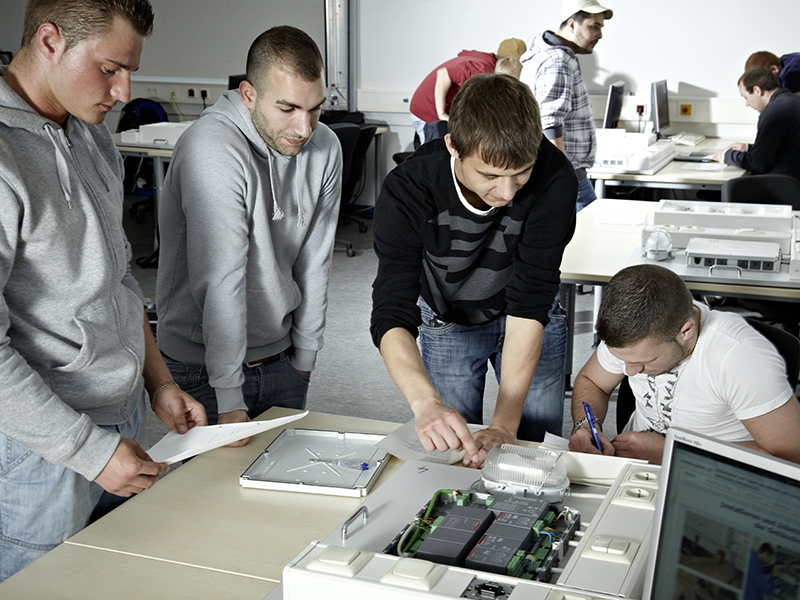
The department’s research and development work can essentially be categorised into three areas: 1. Vocational research (e.g. work process analyses) to identify the skills of skilled workers; 2. The planning, implementation and evaluation of work-process-oriented, skills-enhancing training programmes (learning and work tasks); 3. The development and use of digital media and online tools (rapid e-learning).
Staff
-
 Hergen Auffarth Research associate
-
 Dr. Claudia Fenzl Postdoctoral Researcher, Deputy Department Head
-
 Dr. Vivian Harberts Postdoctoral Researcher
-
 Prof. Dr. Falk Howe Head of Department, Deputy Chairperson
-
 Dr. Lisa Meyne Postdoctoral Researcher
-
 Myrthe Reinsberg Research Associate
-
 Dr. Melanie Schall Postdoctoral Researcher
-
Alexander Seedorf Technical Statt Member, IT Systems Administrator
-
 Dr. Christian Staden Research Associate, Digital Media Coordinator
Projects
-
2025–2026
MissionICH-BOx MV – Development and testing of an e-portfolio concept for careers guidance in Mecklenburg-Western Pomerania based on ‘Mission ICH’
The project is developing and testing a digital e-portfolio concept for career guidance based on the Future-Box, which is being adapted to the framework conditions in Mecklenburg-Western Pomerania and the state programme ‘Mission ICH’. The aim is to promote self-directed learning processes, provide training for teachers and prepare for a state-wide roll-out from the 2026/2027 school year onwards.
-
2024–2027
VETAssIst – Artificial Intelligence as a VET Teaching Assistant
The ‘Artificial Intelligence as VET Teacher Assistant’ (VETAssIst) project is supported by the Erasmus+ KA220-VET funding scheme. Our aim is to further develop vocational education and training by integrating the transformative potential of artificial intelligence (AI) into the day-to-day work of vocational education and training teachers.
-
2024–2027
ISOV – Innovative Skills for an Old Vocation
Like all sectors, the industrial footwear manufacturing sector is also facing the megatrends of globalisation, digitalisation and sustainability. Work processes are changing – and so both initial and continuing vocational training must change as well.
-
2024–2027
CESynergy – Circular Economy Pathways for the Energy Transition
Challenges of the energy transition - - - The energy sector is at a critical juncture: electricity supply systems are a major contributor to greenhouse gas emissions and global warming. In transitioning the energy supply from fossil fuels to renewable energy sources, it is not only the technological and environmental aspects that must be taken into account, but also the necessary material resources.
Dr. Vivian Harberts Myrthe Reinsberg Dr. Andreas Saniter Dr. Julia Tietjen Prof. Dr. Falk Howe
-
2024–2026
FLAME – Modern and efficient fire service career training
As part of the ‘Modern and Efficient Fire Service Career Training’ (FLAME) project, the ITB is supporting the Hamburg Fire Service Academy in modernising and expanding its career training programme for civil servants.
Dr. Claudia Fenzl Dr. Lisa Meyne Nils Weinowski Prof. Dr. Falk Howe
-
2024–2026
FUESE – Strengthening Outreach within the Social Ecosystem of Universities in Central America
In recent years, universities in Central America have undergone profound changes as a result of globalisation, the shift towards a knowledge-based society and advances in information and communication technologies. These changes particularly affect their remit, their governance and their social role. The FUESE project aims to modernise university continuing education by reforming institutional policies and practices in order to strengthen their impact on the socio-economic environment in the region. The project is being implemented in three phases, with all partners involved in the assessment, planning, implementation, evaluation and institutionalisation of a new model designed to improve the effectiveness of university continuing education.
-
2023–2026
DEVISE4KE – Strengthening the sustainable development of vocational education and training in Kenya by integrating workplace-based learning and improving the ICT skills of teachers and pupils through the use of solar energy and energy-efficient equipment
As part of the DEVISE4KE project, three secondary schools offering vocational training programmes in a rural region of Kenya are being equipped with photovoltaic systems and low-energy IT equipment. Through these measures, as well as teaching and learning activities for teachers, the aim is to enable digital-supported and work-based learning for local pupils.
Dr. Vivian Harberts Peter Kaune Dr. Christian Staden Prof. Dr. Falk Howe
-
2023–2026
MULE – Multimedia Learning Environment for Work-Based Learning Tasks for VET Students in the Applied Informatics Sector
The MULE project aims to integrate current trends in applied computer science more effectively into curricula through collaboration between vocational colleges, universities and industry. This is to be achieved by identifying ‘professional fields of activity’ as the basis for learning and work tasks within a multimedia learning environment, with the focus on promoting pupils’ transversal and subject-specific competences. The project also aims to improve the comparability, transparency and recognition of the professional competences of specialists in applied computer science from Germany, Serbia, Italy and Spain through a transnational sectoral qualifications framework (SQF).
Dr. Vivian Harberts Peter Kaune Dr. Christine Siemer Prof. Dr. Falk Howe
-
2022–2025
AI4Ed – AI strategy in educational processes
AI4Ed aims to scrutinise current teaching and learning processes and will incorporate and experiment with innovative technologies (AI) and pedagogy in order to develop tools, methods and assessment systems that respond to the new reality.
Dr. Vivian Harberts Peter Kaune Dr. Andreas Saniter Prof. Dr. Falk Howe
-
2022–2025
BIBB-Lernpfade – BIBB Learning Paths – Shaping in-company training
The aim of the BIBB Learning Paths project is to provide long-term support for training staff in developing their professional competence as training experts. The result is a series of ‘learning pathways’ tailored to the needs of the target group, which enable training staff – including through individually tailored programmes – to align their training plans and processes with the current requirements of their respective sectors. The conceptual basis for this continuing professional development programme is the long-established vocational science concept of the ‘Competence Workshop’ (http://www.kompetenzwerkstatt.net/).
-
2022–2025
Orienta4VET – VET: an attractive and viable pathway. Innovating in VET through guidance processes and exploring flexible and diversified opportunities in VET
The second stage of learning following the completion of lower secondary education is essential both for continuing general and/or vocational education and for successful integration into the labour market (OECD, 2020). According to the OECD, vocational training is regarded as a successful route into the labour market, with countries that have better-developed and more established vocational training programmes being more effective at tackling youth unemployment.
Dr. Vivian Harberts Myrthe Reinsberg Dr. Klaus Ruth Dr. Andreas Saniter Prof. Dr. Falk Howe
-
2020–2023
DUAL ECOsystems – European IT network
Over the course of the project, a compendium of dual training approaches in the information technology (IT) sector in Italy, Germany, Spain and Northern Ireland will be compiled. To this end, all dual training programmes in the participating countries that can be regarded as leading to a full qualification – i.e. at Level 3 or higher of the German/European Qualifications Framework (DQR/EQF) – will be analysed and their strengths and weaknesses described. In Germany, in addition to the traditional dual vocational training programmes in the sector (Level 4), the dual degree programmes at Bachelor’s level (6) and the dual Master’s programme offered by the Department of Computer Science at the University of Bremen at Level 7 will also be included. The aim of the project is to submit a full application under the ‘Centres of Vocational Excellence’ funding scheme.
Dr. Vivian Harberts Dr. Klaus Ruth Dr. Andreas Saniter Prof. Dr. Falk Howe
-
2020–2023
tekom_LandBauMT – Technical communication in the learning and working processes of agricultural and construction machinery mechatronics technicians in the context of Industry 4.0
The ongoing digitalisation and networking in industry and the skilled trades are increasingly changing the requirements and tasks involved in the profession of agricultural and construction machinery mechatronics technician. Factors contributing to this include, amongst others, the increased use of diagnostic, analytical and design software in agricultural and construction machinery engineering, the growing use of high-voltage technology, the increasing interconnection of systems, and augmented, virtual and mixed reality technologies. However, inter-company training programmes for apprentices in agricultural and construction machinery mechatronics do not yet take sufficient account of this digital transformation. The ‘tekom_LandBauMT’ project addresses these challenges by modernising the inter-company training programmes for agricultural and construction machinery mechatronics technicians.
Dr. Vivian Harberts Nils Petermann Michael Sander Prof. Dr. Falk Howe Prof. Dr.-Ing. Maren Petersen
-
2020–2024
Kaefer – Design of a digitally supported, work-process- and skills-based training programme for insulation fitters at KAEFER
In collaboration with KAEFER Industrie GmbH, the ITB is carrying out a project to develop a digitally supported, work-process-oriented and skills-enhancing training concept, which is being implemented in practice as a model for the occupations of ‘Insulation Technician’ and ‘industrial insulator’.
Dr. Christian Staden Dr. Vivian Harberts Alexander Seedorf Prof. Dr. Falk Howe
-
2020–2023
DiaCVET – ‘Development of innovative and attractive continuing professional development programmes in industrial footwear manufacturing’
In many countries, such as Romania (RO) or Portugal (PT), vocational education and training (VET) is regarded as a second-best option; an educational pathway for those who have not managed to gain access to higher education (HE). One of the main reasons for this rather poor image of vocational education and training is that it is often seen as a ‘dead end’; once you have started a ‘blue-collar’ job, there are few or no options for career progression through continuing vocational education and training (CVET). Consequently, roles in more demanding areas of business – such as work in ‘Quality Assurance (QA)’, ‘Design’ or ‘Production Planning’ departments – are reserved for colleagues with a higher education background. But even in countries with established further training programmes such as Germany (DE), where the qualifications of an industrial or craft master or technician are recognised nationwide and enjoy a very good reputation, the trend towards academic qualifications is evident. One worrying indicator for our sector (industrial footwear production) is that, over the last two years, the only industrial foreman training courses in Germany for this profession (IHK Pfalz) could not be held – because not enough participants (only six were needed nationwide!) had applied.
Iris Klein Dr. Klaus Ruth Dr. Andreas Saniter Prof. Dr. Falk Howe
-
2020–2021
IMMO-TEC – Development of practice-oriented and competence-based teaching and learning programmes for the vocational training of estate agents in the field of climate and energy efficiency
The project proposal “IMMO-TEC: Development of action-oriented and competence-based teaching and learning arrangements for the vocational training of estate agents in the field of climate and energy efficiency” falls within the strategic future field of ‘Space’ – project family: ‘Climate-friendly Construction’. For the construction industry – and, consequently, the property sector as well – new requirements in day-to-day professional practice and the associated practical skills of employees will be necessary in the future, specifically in relation to the Rhineland mining region.
-
2020–2023
SteBs – Structural Development in Vocational Teacher Training
The SteBs project has the overarching aim of structurally strengthening and further expanding vocational teacher training in Bremen, thereby contributing to the vocational education dialogue in Bremen. Based on cross-phase and cross-subject collaboration between the stakeholders involved in vocational teacher training, concepts for promoting teachers’ professional competence are being developed and tested. The project is being carried out in close collaboration between ITB, the IPP (Institute for Public Health and Nursing Education, Prof. Dr Ingrid Darmann-Finck), the Department of English Language Teaching (FB 10, Prof. Dr Sabine Doff) and the Department of Physics Teaching (FB 01, Prof. Dr Christoph Kulgemeyer).
Dr. Claudia Fenzl Dr. Lisa Meyne Myrthe Reinsberg Michael Sander Dr. Andreas Saniter Nils Weinowski Prof. Dr. Alisha M. B. Heinemann Prof. Dr. Falk Howe
-
2020–2021
Scientific support and media education design for the development of an e-portfolio for career guidance – Career Choice Passport 4.0
The aim of the ‘Career Choice Passport 4.0’ (BWP 4.0) development project is to develop and trial an e-portfolio for use nationwide and across all types of schools, designed to support self-directed learning as part of pupils’ career guidance.
-
2019–2022
DT4VET – Design Thinking Tools for Educators
The ‘reflective practitioner’ has been regarded for many years in vocational education and training as the ideal model of a skilled worker – yet this concept has rarely been applied to the field of vocational education and training teachers. The ERASMUS+ project DT4VET regards DESIGN THINKING (DT) as a key method for fostering reflective practices amongst vocational education and training teachers. DT has the potential, in particular, to promote transversal skills, such as creative and critical thinking, taking the initiative and working collaboratively. Seven partners from four countries (Turkey, Finland, Italy and Germany) are developing, piloting and evaluating a professional development seminar on the Design Thinking method for vocational school teachers.
Dr. Vivian Harberts Peter Kaune Iris Klein Dr. Andreas Saniter Prof. Dr. Falk Howe
-
2019–2022
StepUP – Supporting Tutor’s Educational and Professional Upgrade
Work-process-oriented learning plays a fundamental role in successful vocational training programmes: it enables trainees to acquire the skills and competences required in real-world workplaces. Alongside the trainees, the key players here are the skilled workers who support the training process; depending on the context and sector, they may also be referred to as mentors, tutors or training officers. Unlike teachers and full- or part-time trainers, however, these mentors have little or no formal teaching qualifications. This is where the ERASMUS+ project StepUP comes in: Drawing on examples of good practice from the four participating countries – Germany, Italy (IT), Lithuania (LT) and Spain (ES) – training modules are being developed, delivered and evaluated to enhance the teaching skills of mentors, particularly in the context of new technologies.
Dr. Vivian Harberts Iris Klein Dr. Andreas Saniter Prof. Dr. Falk Howe
-
2019–2020
ProSoKom – Professionalising company-based training in the automotive trade through digital media to develop apprentices’ social competences
ProSoKom aims to develop social competences among automotive apprentices and young people in the transition system. It addresses current social competence challenges as a basis for developing and implementing a work-process-oriented competence development approach, using digital media in suitable forms and to an appropriate extent. The measures particularly include refugees and young people from migrant backgrounds.
-
2019–2022
O4YEL – Supporting Educational and Social Inclusion of Early School Leavers and Youth at Risk of Early Leaving through Mechanisms of Orientation and Tutorial Action
The O4YEL project aims to develop, implement and evaluate innovative strategies and practices for providing guidance and support to young people who are at risk of leaving the formal (general and vocational) education system prematurely, i.e. without a qualification. In particular, mentoring initiatives are being developed and implemented that are designed to promote inclusive education for young people and help prevent them from dropping out of school or training. The project consortium comprises partners from Spain, Portugal, Romania, the UK and Germany.
-
2019–2020
KofeBS II – Assessing the competences of semi-skilled and unskilled people at vocational schools in preparation for an external examination
The KofeBS follow-up project extends and evaluates competence assessment for semi-skilled and unskilled recipients of benefits under Books II and III of the German Social Code and employees without vocational qualifications to further training occupations. It also examines whether competence assessments and continuing training can be sustainably established at vocational schools. Funded by the European Social Fund (ESF), it operates under the Senator for Economic Affairs, Labour and Europe’s state programme ‘Progress through Education and Guidance’.
-
2018–2022
Pro-VET – Enhancing the Professional Development of Vocational Education Teachers in Russia and Serbia with European Practices
A key factor behind the differences in the quality and standing of vocational education and training across European countries and beyond lies with the teachers themselves. The selection, initial and continuing training, and employment conditions of vocational school teachers vary considerably. The Pro-VET project focuses on developing uniform teacher training objectives in Serbia and Russia, as well as online resources to help achieve these. The methodological approach is ‘policy learning’; in other words, the aim is not to export European solutions (which do not exist in this form anyway), but to further develop the existing teacher training systems in Serbia and Russia by drawing on examples of good practice from individual EU countries.
-
2018–2020
WaBeQ – Skills Workshop
The ‘WaBeQ – Competence Workshop’ project examines the extent to which digital media can be used to ensure that the training of young people with special educational needs is appropriately structured. To this end, in a collaborative development process with the training staff at the Waller Employment and Qualification Society (WabeQ), the key elements of the vocational science-based ‘Competence Workshop’ concept are being developed, tested and optimised to create a work-process- and competence-oriented, digitally supported vocational training programme.
-
2018–2021
FutureBOx – Developing and testing an e-portfolio for career guidance for high-achieving upper secondary pupils
The project develops and tests an e-portfolio to support career guidance for upper secondary pupils in Bremen as part of a ‘Special programme for career guidance for high-achieving pupils’ under the federal–state ‘Education Chains’ agreement. It builds on an e-portfolio concept for career guidance already developed at the ITB through the Berufswahlpass.online project.
-
2018–2021
TEACH-VET – Platform for self-assessment and development of the teaching competence for VET teachers and trainers
The aim of the EU project is to develop an electronic tool for the self-assessment of the teaching competences of vocational school teachers and trainers and to provide them with teaching materials for further qualification tailored to their individual results. The development of the tool is based on an analysis of teaching processes in initial VET and thus of the development of pedagogical competences, on the identification of existing systemic problems and bottlenecks, and on the needs of the teachers and trainers themselves. Based on the findings, the content of the online tool for assessing and developing the teaching competence of VET teachers and trainers is designed.
-
2018–2022
LIKA 4.0 – Digitally supported cooperative learning through customer orders; sub-project: developing and testing the overall teaching approach
The “LIKA 4.0” project brings together a large research and development consortium – comprising thirteen industry partners from the commercial and technical skilled trades sector, the Akademie Zukunft Handwerk, the digital agency Interlutions and the ITB – to focus on the development, testing and institutionalisation of digitally supported continuing professional development in the skilled trades (AM-SHK, EEG) with a view to designing in-company training programmes that are work-process and competence-oriented, using a training management system. The development and testing of the continuing professional development programme and the training management system are carried out iteratively and cyclically, based on design-oriented approaches from Design-Based Research.
-
2018–2019
Berufsschule digital – Vocational schools and their role in strengthening education in the digitalised world
In early April 2018, ten vocational schools were selected to engage intensively for almost two years with concepts and solutions for the digitalisation of VET, particularly in the context of teaching and school development. The aim of the ‘Berufsschule digital’ network, launched by the Deutsche Telekom Stiftung, is to identify examples of good practice through exchange between the schools, develop them further and make them available beyond the network. The participating workshop schools receive continuous research support from the Institute for Information Management Bremen (ifib) and the Institute Technology and Education (ITB) at the University of Bremen. On behalf of the Deutsche Telekom Stiftung, the two institutes support the schools in their workshop process.
-
2017–2020
ICSAS – Integrating Companies in a Sustainable Apprenticeship System
ICSAS (‘Integrating Companies in a Sustainable Apprenticeship System’) offers countries without workplace learning experience first-hand insight into how this training system works, using the footwear industry. Work-based learning (WBL) is a promising approach to developing apprentices' occupational competence and strengthening their identification with their occupation and training company. Germany's dual VET system structurally incorporates real work processes' learning potential through alternating company and vocational school learning venues. In school-based systems such as Romania's and Portugal's, this potential remains untapped. ICSAS aims to demonstrate its use through a one-year dual programme in the footwear industry in Romania and Portugal, modelled on German dual training, and ultimately to incorporate dual elements into those countries' training regulations.
-
2017–2018
KofeBS – Assessing the competences of semi-skilled and unskilled people at vocational schools in preparation for an external examination
KofeBS develops and tests a competence assessment procedure at four vocational schools in Bremen. Its target group comprises semi-skilled and unskilled recipients of benefits under Books II and III of the German Social Code and employees without vocational qualifications. Tailored individual training measures will prepare them for external examinations. Funded by the European Social Fund (ESF), the project operates under the Senator for Economic Affairs, Labour and Ports' state programme ‘Progress through Education and Guidance’.
Dr. Vivian Harberts Dr. Michael Reinhold Prof. Dr. Falk Howe
-
2017–2020
MeMoApp – Media competence for mobile, app-based working and learning
The MeMoApp project, funded by the Federal Ministry of Education and Research and the European Social Fund, addresses professional drivers, an occupation with a particularly high degree of mobility. The occupational profile has changed fundamentally in recent years. Rising cognitive demands and the consequences of mediatisation and digitalisation confront employees with new challenges. Promoting media competence is an important prerequisite for meeting these challenges. To this end, MeMoApp has developed a company media education concept, under the umbrella term MekoSmartHub, as the basis for systematically integrating the promotion of media competence into the company’s working and learning culture. In addition, a mobile app that supports professional drivers in their daily work was developed in close cooperation with the practice partners.
-
2016–2020
TEEDE – Towards Excellence in Engineering Curricula for Dual Education
The project aims to modernise, broaden and internationalise higher education in Germany, Spain, Finland, Italy, Russia, China, Cambodia and India. It also supports intercultural and personal exchange and, in non-EU countries, closer alignment with European higher education developments. Partners identify needs and key sectors and, guided by European experts, modernise curricula, particularly through dual degree programmes integrating company-based learning. A system of continuing professional development and student advisory centres will be established at universities in non-EU countries. Key outputs are new or revised engineering curricula based on a common methodology combining local labour-market analysis and innovative dual provision.
Iris Klein Dr. Andreas Saniter Nils Weinowski Prof. Dr. Falk Howe
-
2016–2017
HSB flex – Evaluation of university of applied sciences degree programmes
Formative evaluation of the HSBflex project at Bremen University of Applied Sciences: The study examined the extent to which the measures introduced to facilitate flexible study programmes – ranging from the recognition of formally and informally acquired skills, through bridging modules and blended-learning modules, to professional development programmes for teaching staff and a mentoring programme – in the Bachelor’s degree programme in Mechatronics and the Master’s degree programme in Business Management – achieve their objectives.
-
2016–2019
IntAGt – Integrating preventive occupational health and safety into initial and advanced training occupations in Industry 4.0
The IntAGt collaborative project was part of the BMBF funding priority ‘Preventive measures for the safe and healthy work of tomorrow’. Its aim was to develop and implement measures to promote healthy skilled work conducive to learning in digitalised industrial production. The project’s starting point was the central thesis that skilled workers, as (co-)designers of their own work, and managers alike need the competence to design work in ways that promote health. Work analyses using an analytical procedure combining methods from occupational psychology and occupational science made it possible to describe the occupational fields of activity of assembly, system operation and maintenance in terms of competence requirements as well as health-promoting and stressful working conditions. On this basis, various learning and teaching concepts aimed at in-company training, vocational schools and advanced training institutions, such as technician schools, were developed, tested and made available.
Dr. Claudia Fenzl Annette Baimler-Dietz Christian Daniel Dr. Christian Staden Raphael von Galen Prof. Dr. Falk Howe
-
2016–2019
DMi! – Inclusive digital media. Connecting digital media and inclusive learning in primary schools and teacher education
DMi! therefore aimed to embed core media-didactic competences in the curriculum through seven concrete concepts. Broad cooperation connected subject didactics in German, mathematics, primary science and social studies, and work studies with computer science, educational psychology and media education. Addressing heterogeneity, a particular focus of Bremen teacher education, links the concepts: digital media's potential can be used particularly effectively for individual support across subjects. The seven concepts thus also contribute to developing shared learning in inclusive classrooms.
-
2016–2018
DigiProB – A learning concept and tool system for integrating learning and experience in the construction industry
DigiProB was funded by the Federal Ministry of Education and Research from 1 March 2016 to 31 October 2018 under ‘Digital Media in VET’ (DIMEBB 2). At Bau ABC, northern Germany's largest inter-company construction training centre, it used digital tools to redesign advanced training for construction team leaders, foremen and certified site supervisors towards stronger action orientation.
Dr. Ludger Deitmer Dr. Lars Heinemann Werner Müller Dr. Christian Staden PD Dr. Rainer Bremer Prof. Dr. Falk Howe
-
2016
naMeko – Operationalisation of the concepts of ‘IT and media literacy as entry requirements for vocational training’
On behalf of (and in cooperation with) the Federal Institute for Vocational Education and Training (BIBB), and in collaboration with the Institute for Information Management Bremen GmbH (ifib), this study examines the question of what media and IT skills pupils should possess upon entering vocational training in order to meet the increased demands of a ‘digitalised world of work’. To this end, the study addresses the following areas: •
-
2015–2018
METALS – Machine Tool Alliance for Skills
Developing innovative learning units on new machine-tool technologies: METALS used a collaborative, cross-national comparative approach to develop learning units that would help apprentices and skilled workers close the gap between existing qualifications and future requirements.
Dr. Ludger Deitmer Pekka Kämäräinen Dr. Michael Reinhold Dr. Andreas Saniter Prof. Dr. Falk Howe
-
2015–2018
ProBBP – Professional analysis, conceptual development and pilot implementation of a part-time bachelor’s programme in vocational and workplace education
ProBBP aimed to develop and pilot a bachelor's programme in Vocational and Workplace Education building on the advanced qualifications ‘Certified Vocational Educator’ and ‘Certified Initial and Continuing Training Educator’, thereby contributing to the professionalisation of continuing education personnel.
Werner Müller Dr. Klaus Ruth PD Dr. Rainer Bremer Prof. Dr. Falk Howe
-
2015–2018
HAKS – Craft training for climate protection
Buildings are a major starting point for climate protection, accounting for around 40% of Germany's CO₂ emissions. Achieving national climate targets requires energy consumption reductions of approximately 80–90% by 2050. Current renovation rates indicate an urgent need for action. HAKS aimed to overcome key, frequently cited barriers to highly energy-efficient renovation sustainably and in the long term. Its focus included networking, understanding other trades' working requirements, updating knowledge of technical solutions and alternative materials and products, using digital media, and improving company training and cooperation.
Werner Müller Dr. Klaus Ruth Alexander Seedorf Dr. Christian Staden Prof. Dr. Falk Howe
-
2015–2018
nabus – Sustainable construction and renovation – Cross-trade training for trainers and apprentices
NaBuS trains VET personnel in northern Germany as multipliers for sustainable vocational education.
Dr. Joanna Burchert PD Dr. Rainer Bremer Prof. Dr. Falk Howe
-
2015–2017
P4LLL-Tec – Partnerships for lifelong learning in engineering and technology
The project examined different models of cooperation between VET and higher education stakeholders designed to enable coherent learning pathways from initial training to university level and improve permeability between educational sectors.
Dr. Ursel Hauschildt Dr. Klaus Ruth PD Dr. Rainer Bremer Prof. Dr. Falk Howe
-
2015–2017
DiMBA – Digital media in company-based vocational education and training
In cooperation with the Institute for Information Management Bremen GmbH (ifib) and on behalf of (and in cooperation with) the Federal Institute for Vocational Education and Training (BIBB), this research project investigated the use of digital media in company-based training practice and, on this basis, developed materials for training staff. The central questions of the research and development project were: How do in-company training staff select digital media for everyday initial and continuing training practice? How are digital media integrated into initial and continuing training processes? What support do in-company training staff need in order to integrate digital media optimally into initial and continuing training?
-
2015–2016
Vocational Trainer@Skills Development Phase II
(Extension of the BP@Kom II project) The ‘Berufspädagoge@Kompentenzerweiterung’ project focuses on the development, piloting and long-term establishment of the part-time Bachelor’s degree programme in ‘Vocational Education and Training’. It is based on a ‘triple-track approach’ aimed at the professionalisation of vocational trainers (IHK), trainers and further education providers, as well as other vocational target groups (e.g. technicians and master craftsmen).
-
2014–2016
EkoZet Learning Space – Development and testing of teaching and learning modules for using EkoZet as a vocational training learning space for innovative energy technology
Taking into account the growing diversity of technologies and approaches to implementing solutions aimed at highly efficient energy use presents a constant challenge for vocational schools, workplaces and inter-company training centres (ÜBA), not least because of the investment and resources required.
-
2014–2016
dualTRAIN – Development of a sustainable approach to introducing the dual vocational training system in Portugal and Spain
The aim of the dualTRAIN project is to develop an approach for introducing a dual vocational training system, such as that which already exists in Germany, in Portugal and Spain within the footwear industry. A preparatory step in this regard is to examine the German dual training system as it applies to the footwear industry by means of a qualitative SWOT analysis.
Dr. Andreas Saniter PD Dr. Rainer Bremer Prof. Dr. Falk Howe
-
2014
LuRa – Apprenticeship in Aerospace Service Technologies – Improving the quality of training
The project addresses the regional shortage of skilled workers in the aircraft maintenance sector (MRO). The reorganisation of aircraft maintenance occupations, which came into effect in August 2013, has created a fundamental need to restructure vocational training in this field. The project aims to support vocational colleges and training organisations in the effective implementation of the necessary processes.
-
2012–2015
LernenPlus – Promoting digital media literacy in entry-level vocational training
The project aims, within the context of what is known as ‘entry-level qualification’ (EQ) and using the ‘Chance plus’ programme as an example, to develop, test and roll out new approaches to promoting career-oriented media literacy amongst disadvantaged young people and the educational staff who work with them.
Dr. Andreas Saniter Dr. Joanna Burchert Dr. Eileen Lübcke Alexander Seedorf Prof. Dr. Dr. h.c. Michael Gessler
-
2012–2017
BWP.online – CAREER CHOICE PASS.online
Since 2000, the Career Choice Passport has been used in general education schools in the form of a folder as a portfolio-based approach to support teaching and learning, with the aim of assisting pupils in their career guidance process. In a doctoral project spanning several years, the portfolio concept underlying the Career Choice Passport was used as a reference for the design of an e-portfolio concept in career guidance. In an iterative, cyclical research and development project based on the design-based research approach, both a web-based e-portfolio system – as a technical element – and a didactic framework for e-portfolio work in career guidance – as a pedagogical element – were developed and tested in school settings.
-
2012–2014
KWST2.0 – Skills Workshop 2.0 – My Career
Development of a software-supported teaching and learning concept to strengthen work-process-oriented and media-supported dual vocational training. The focus was on a modular software framework comprising three key tools (portfolio, task manager and skills assessment) designed to provide digital support for the organisation of learning, learning support and reflection on vocational work and learning processes.
-
2011–2012
StugaNHES – Needs analysis for a degree programme in Sustainable Energy Systems within the consortium of universities and the University of Bremen
The aim of this exploratory study was to assess the regional needs, the prospects of success, the framework conditions and the necessary content for a degree programme in ‘Sustainable Energy Systems’ within the engineering departments of the universities in the State of Bremen.
-
2011–2014
Waterbiotech – Biotechnology for Africa’s sustainable water supply
Africa, the world’s second driest continent, faces mounting challenges in providing sufficient safe water for its growing population. Wastewater treatment technologies and reuse applied to the treatment of polluted water resources can play an important role in addressing this challenge. The WATERBIOTECH project has been designed to find an appropriate solution to water scarcity in Africa.
-
2011–2014
IQ‐Evaluation – IQ Evaluation – Evaluation of the ‘State-Certified Mechanical Engineering Technician’ course
The IQ-Technikum has opted for a blended-learning approach for the part-time training programme leading to the qualification of ‘State-Certified Technician – specialising in Mechanical Engineering’, which is subject to the regulations governing distance learning.
-
2011–2012
ILA – Innovative Learning in Automation Technology
The aim of the ILA pilot project is to incorporate more advanced automation technology content into the curricula of vocational schools.
-
2011–2012
Lura – Service techniques in the aerospace industry
The Bremen site is of supra-regional importance to the European aviation industry. However, the local labour market lacks the skilled workers required for this, particularly in the field of authorised service technicians.
-
2010–2012
ELEESA – Discovery-based learning on the topic of renewable energy in general studies for the early years and primary years
Education for sustainable development is an ongoing, lifelong process of learning and development. This project introduces children, students, teachers and nursery staff to a topical issue through practical experience. The aim is to raise their awareness of environmental issues and to highlight evaluation criteria and possible courses of action.
-
2010
RIS‐Studie – RIS Study – Identifying and organising study programmes in renewable energy and energy efficiency
On behalf of the Kompetenzzentrum Zukünftige Energieversorgung e. V., all degree programmes relating to renewable energy and energy efficiency in the Weser-Ems administrative district and the state of Bremen were surveyed and analysed between April and October 2010. The study is intended to serve as a basis for the systematic improvement and expansion of existing degree programmes, as well as for the further development and promotion of regional expertise.
-
2009–2010
ECBP Äthiopien II – ECBP Ethiopia II – Training of vocational school teachers in Ethiopia
A vocational education and training system is to be developed in Ethiopia, comprising, amongst other elements, a three-tier system of vocational training in industrial and technical trades. Depending on the duration (six months to four years) and the balance between theoretical and practical components of the training, there are to be three different types of vocational college teachers.
-
2008–2011
Electrical Trades Skills Workshop
Kompetenzwerkst@tt Elektrohandwerk is dedicated to the development, testing and nationwide roll-out of a work-process-oriented, software-supported and cross-venue training concept for the apprenticeship in electronics specialising in energy and building services engineering. A key element of this was a learning software programme based on professional work processes and typical client projects.
-
2005–2007
CACDFM – Computerised Assistance for Clothing Design and Fashion Management
The aim of the project was to develop training packages and teaching expertise in the field of clothing design and fashion management for Bangladeshi garment workers, students and teachers, based on an existing pattern-making and management system called COAT (CAD and Office Applications for the Tailors’ Trade) developed by the University of Bremen. This two-year project aimed to make suitable software tools available to students, professionals and relevant SMEs. It also promoted the transfer of know-how and information technology between the partners and individual target groups. A further outcome of the project was to upgrade the skills of semi-skilled garment workers, thereby improving their employment prospects in Bangladesh and abroad.